Criticality-Guided Data Collection Reduces Embodied Policy Failures
A learned predictor of future failure guides data collection toward risky states, with reported failure-rate reductions of 51–67% against trained baselines.
All facets of automatic control systems, theory and experiment.
A learned predictor of future failure guides data collection toward risky states, with reported failure-rate reductions of 51–67% against trained baselines.
DSO measurements combine 200 one-minute low-voltage feeder series with weather and metadata for reproducible distribution-grid forecasting studies.
The reactor acts as an electromagnetic resonator, giving near-unity coil-to-susceptor coupling and 67% measured RWGS system efficiency at comparable conditions.
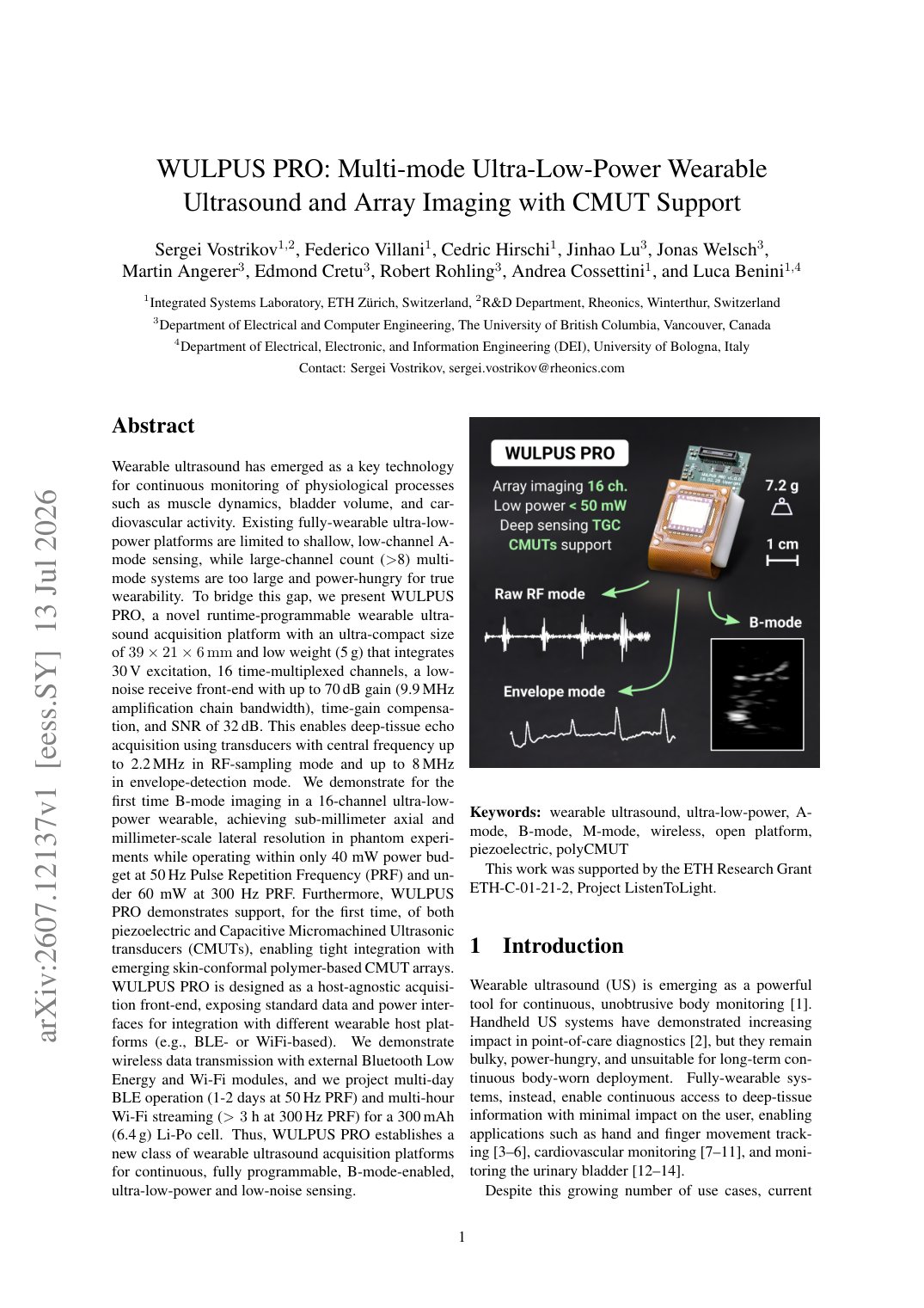
WULPUS PRO combines 16 multiplexed channels, programmable excitation, and host-agnostic wireless interfaces in a 5 g module consuming under 60 mW.
A BEOL 1T-1MR stack combines VO₂ nanosheets with junctionless FETs, producing 40–410 kHz spiking at 18 pJ per event.
State-dependent perturbation bounds prove GASp, stochastic ISS, and two backstepping guarantees for nonlinear SDEs.
Mach-Zehnder readout and power-over-fiber match conventional 3T coil SNR with 5–10 mW modulator drive and fiber-only links.
A three-port dq/DC admittance test separates self and coupling failures, guiding a DE-OSR controller that stabilizes weak-grid operation without extra tuning.
A real-time controller caps only binding trains, restoring 25 kV corridor feasibility with 7 seconds of delay instead of 210.