Whole-Study MIL Improves Prenatal CHD Screening
Masked-autoencoder pre-training, disease-robust cardiac-frame gating, and transformer pooling produce study-level CHD predictions without clinician-selected frames.
Oct 10, 20264 min2609.31376
Formation, processing, analysis, and display of images and video.
Masked-autoencoder pre-training, disease-robust cardiac-frame gating, and transformer pooling produce study-level CHD predictions without clinician-selected frames.
A pretrained CMR foundation model combines image analysis with local language-model reporting, reaching 81.4% expert agreement across a 68-subject clinical cohort.
Three IDC analysis-result datasets combine standardized DICOM segmentations, measurements, and viewers, making NLST-derived annotations queryable without local image-processing infrastructure.
An anatomy-change-aware 2.5D model uses bidirectional slice memory and uncertainty-guided review to cut reader contouring time by 75–80% in a 17-oncologist study.
Nested anatomical embeddings from non-contrast cardiac CT reached 0.866 AUROC for 10-year MACE prediction, exceeding the strongest engineered-imaging baseline by 0.040.
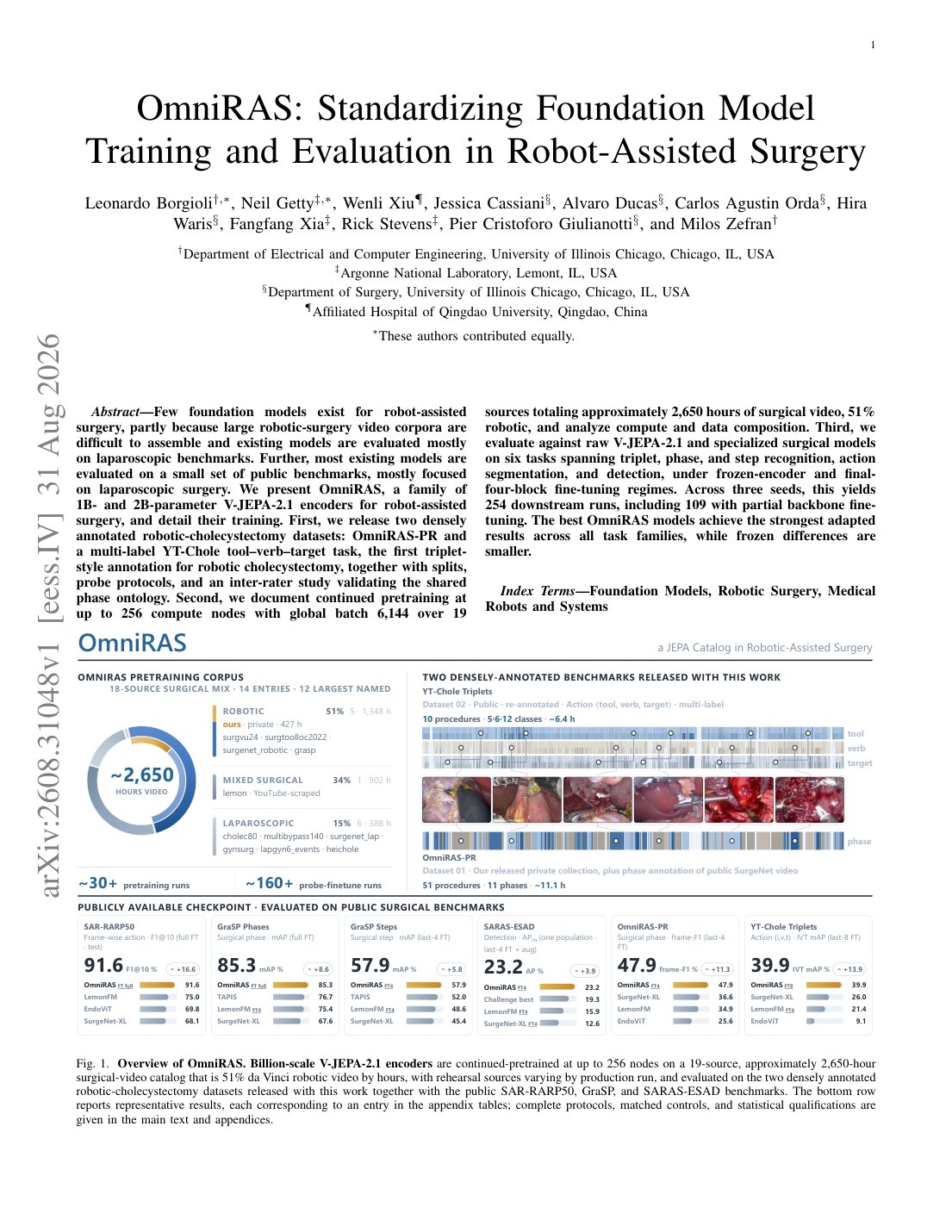
Continued V-JEPA-2.1 pretraining on approximately 2,650 hours of surgical video improves partially fine-tuned performance across six robotic-surgery task families.
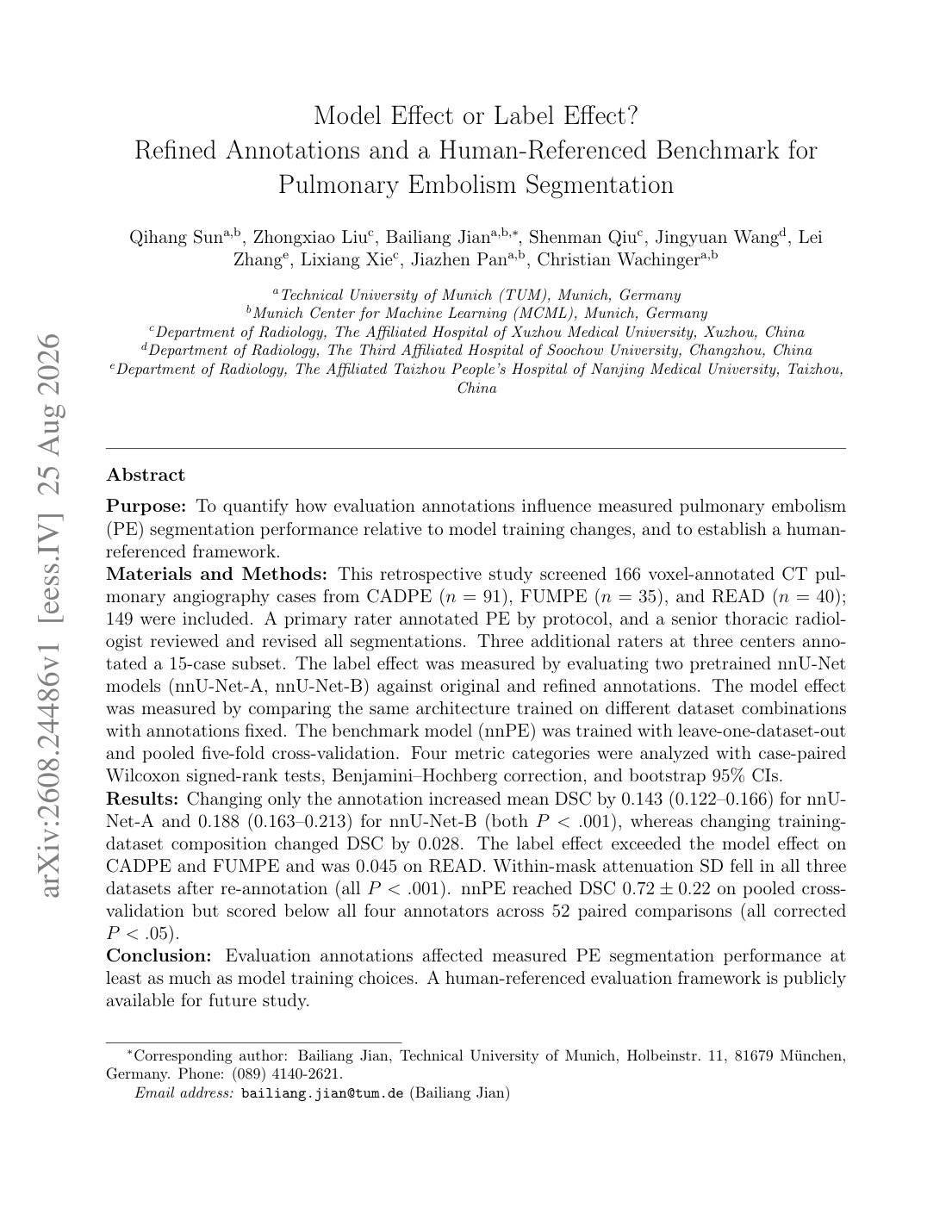
Radiologist-reviewed masks raise measured nnU-Net Dice scores by 0.143–0.188, exceeding score changes from altering training-data composition.
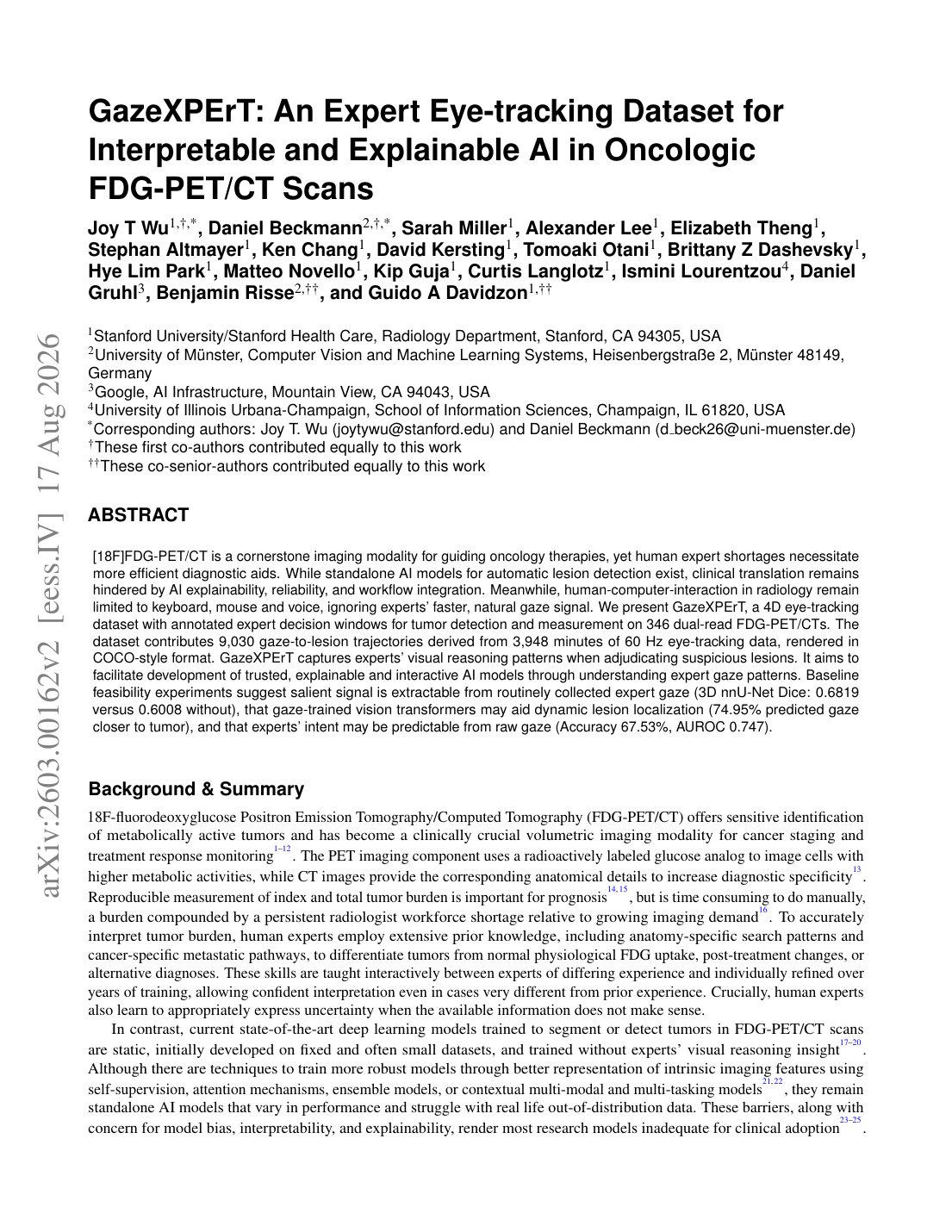
A 60 Hz eye-tracking dataset links radiologists’ decision windows to lesions, raising a 3D nnU-Net baseline from 0.6008 to 0.6819 Dice.
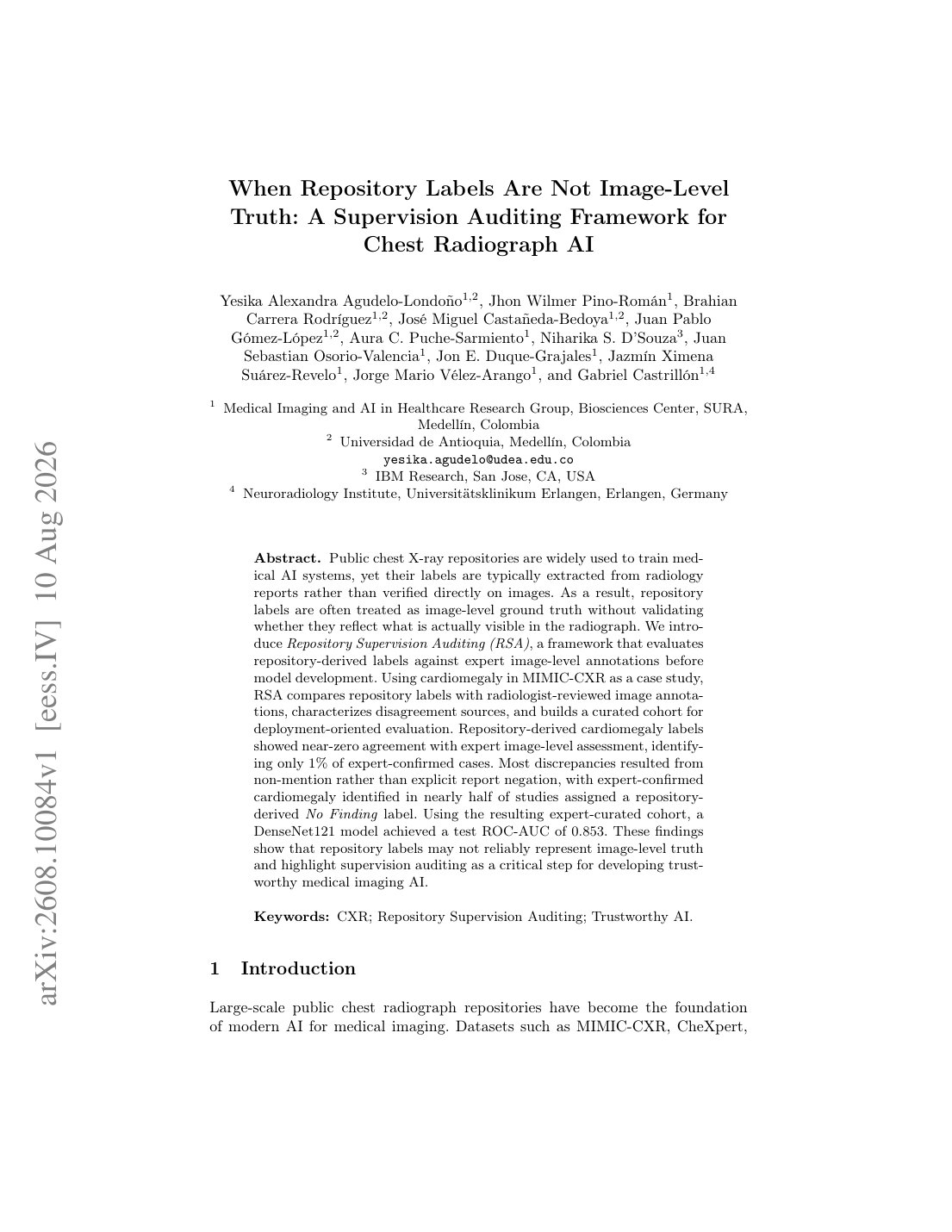
Auditing report-derived MIMIC-CXR labels against radiologist image review found only 1% case capture; a curated-cohort DenseNet121 reached ROC-AUC 0.853.
Paired image and report annotations expose label-source bias, including 59% of image-positive findings absent from reports.