Diffeomorphic Traces Fail To Detect High-Dimensional Knots
Generalized RBG links and a Plotnick-based construction give counterexamples in every dimension $n \geq 4$, while preserving trace detection for the unknot.
Underlying Paper
On the detection of knots by their traces in high dimensions
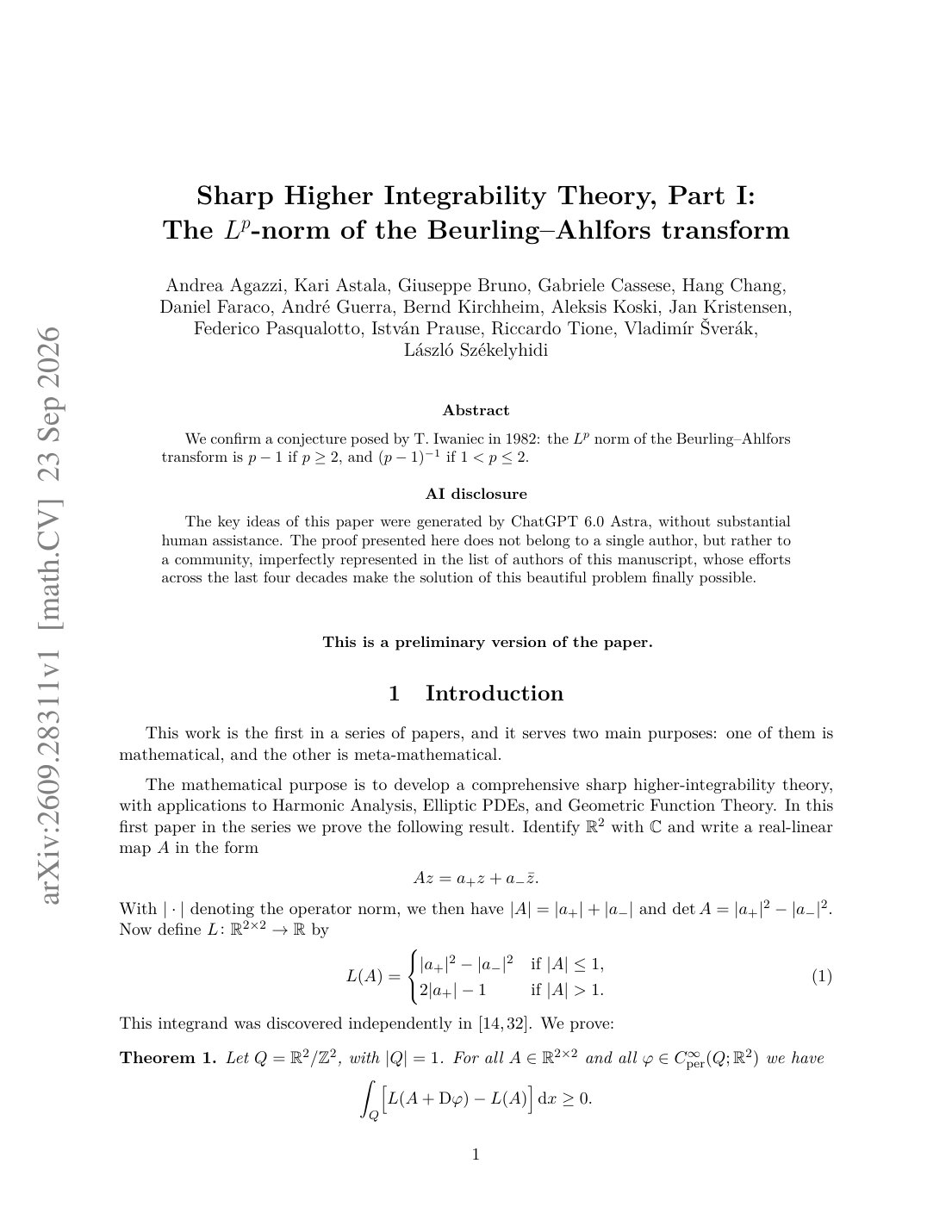
For every $n \geq 4$, we demonstrate the existence of non-isotopic, smooth $(n-2)$-knots in $S^n$ with diffeomorphic traces. We give two proofs: the first by generalising the RBG link construction to all dimensions, and the second as an application of work of Plotnick. Conversely, we prove that for every $n \geq 4$, the unknot in $S^n$ is detected by the diffeomorphism type of its surgery and hence of its trace.
A surgery trace packages a knot together with the handle attachment induced by surgery, so it is natural to ask how much of the original embedding survives in its diffeomorphism type. In low-dimensional knot theory, related surgery questions are already subtle. This paper shows that in codimension two and dimensions , the trace is not a complete invariant: distinct smooth -knots in can have diffeomorphic traces.
Core Contribution
The main theorem is an existence result for every . The authors construct pairs of non-isotopic smooth -knots in whose traces are diffeomorphic. The point is sharper than showing that a familiar invariant fails to distinguish knots: even the full smooth diffeomorphism type of the surgery trace can forget the isotopy class of the attaching knot.
The paper also establishes the opposite statement for the simplest knot. For every , if surgery on a knot has the same diffeomorphism type as surgery on the unknot, then the knot is itself unknotted; equivalently, the unknot is detected by its surgery and hence by its trace. Together, the two theorems draw a useful boundary. Trace diffeomorphism is too coarse to classify all high-dimensional knots, but it still recognizes the trivial class.
Technical Approach
The first proof extends the RBG-link construction to all dimensions under consideration. The construction organizes several embedded components and their associated surgery data so that different choices of attaching knot produce traces related by a diffeomorphism, while the resulting knots remain non-isotopic. The geometric work is in separating those two conclusions: a handle-level equivalence of traces does not automatically imply equivalence of the embedded knots.
The diagrams make that distinction tangible. The band-sum picture used in the construction relates arcs and their associated knots through an isotopy region, while the Kirby-diagram viewpoint records the corresponding surgery data. These are complementary descriptions of the same strategy: manipulate the handle presentation enough to identify traces, then retain a knot-theoretic obstruction to isotopy.
Figure 6 depicts the key handle-theoretic move: a surgery diffeomorphism is extended across the traces. That extension is the bridge from an equivalence of surgery boundaries to an equivalence of the higher-dimensional cobordisms themselves. It clarifies why the paper's counterexamples concern traces rather than merely manifolds obtained after surgery.
A second, independent proof invokes work of Plotnick. Its value is not just redundancy. The RBG argument supplies an explicit geometric mechanism, whereas the Plotnick route places the phenomenon within an existing high-dimensional surgery framework. Agreement between the two routes makes the dimension-uniform conclusion more convincing than a construction supported by a single diagrammatic argument.
Results and Analysis
There are no numerical experiments or benchmark tables here; the evidence is theorem-and-construction based. The paper proves the existence of counterexamples for every integer , rather than for a sporadic dimension or a restricted family. That quantifier is the substantive result. It rules out any attempt to recover arbitrary smooth codimension-two knots from trace diffeomorphism across the entire stated range.
The complementary unknot theorem prevents an overly broad reading. The trace loses enough information to identify some distinct nontrivial knots, yet it does not lose the information needed to distinguish the unknot. This is a more informative conclusion than a blanket failure statement: it identifies a genuine obstruction to classification while retaining a detection theorem at the base point of knot theory.
For practitioners in geometric topology, the practical consequence is methodological. Arguments that infer knot isotopy from a diffeomorphism of surgery traces need additional hypotheses in dimensions . Conversely, results targeting the unknot can still use trace or surgery type as a decisive invariant. The paper establishes the dividing line, but does not offer a classification of which nontrivial knots are detected.
Scope and Caveats
The results are smooth and high-dimensional, beginning at . They do not by themselves settle analogous questions for lower-dimensional knots, nor do they characterize all pairs with diffeomorphic traces. The constructions establish existence, not an algorithm for deciding trace detection from a knot description. That leaves the central structural question open: what extra invariants, attached to a trace or its surgery presentation, recover the knot information that trace diffeomorphism discards?
Evidence Box
theoreticalKey Claims
- •Diffeomorphic traces need not determine smooth codimension-two knots
- •The RBG link construction extends to all dimensions n ≥ 4
- •The unknot is detected by surgery and trace diffeomorphism
Key Results
- •Existence of non-isotopic smooth (n−2)-knots with diffeomorphic traces for every n ≥ 4
- •Two independent proofs cover the full range n ≥ 4
- •Unknot detection holds for every n ≥ 4
Limitations & Caveats
- •Results begin at dimension n = 4 and do not address lower-dimensional cases
- •Existence constructions do not classify all knots with diffeomorphic traces
- •No decision procedure is given for trace detection from a knot presentation