Forbidden Bicliques Bound Tree-Independence in P5-Free Graphs
A decomposition-repair proof establishes a $4\ell-4$ bag-independence bound when induced $P_5$ paths and $K_{\ell,\ell}$ bicliques are excluded.
Underlying Paper
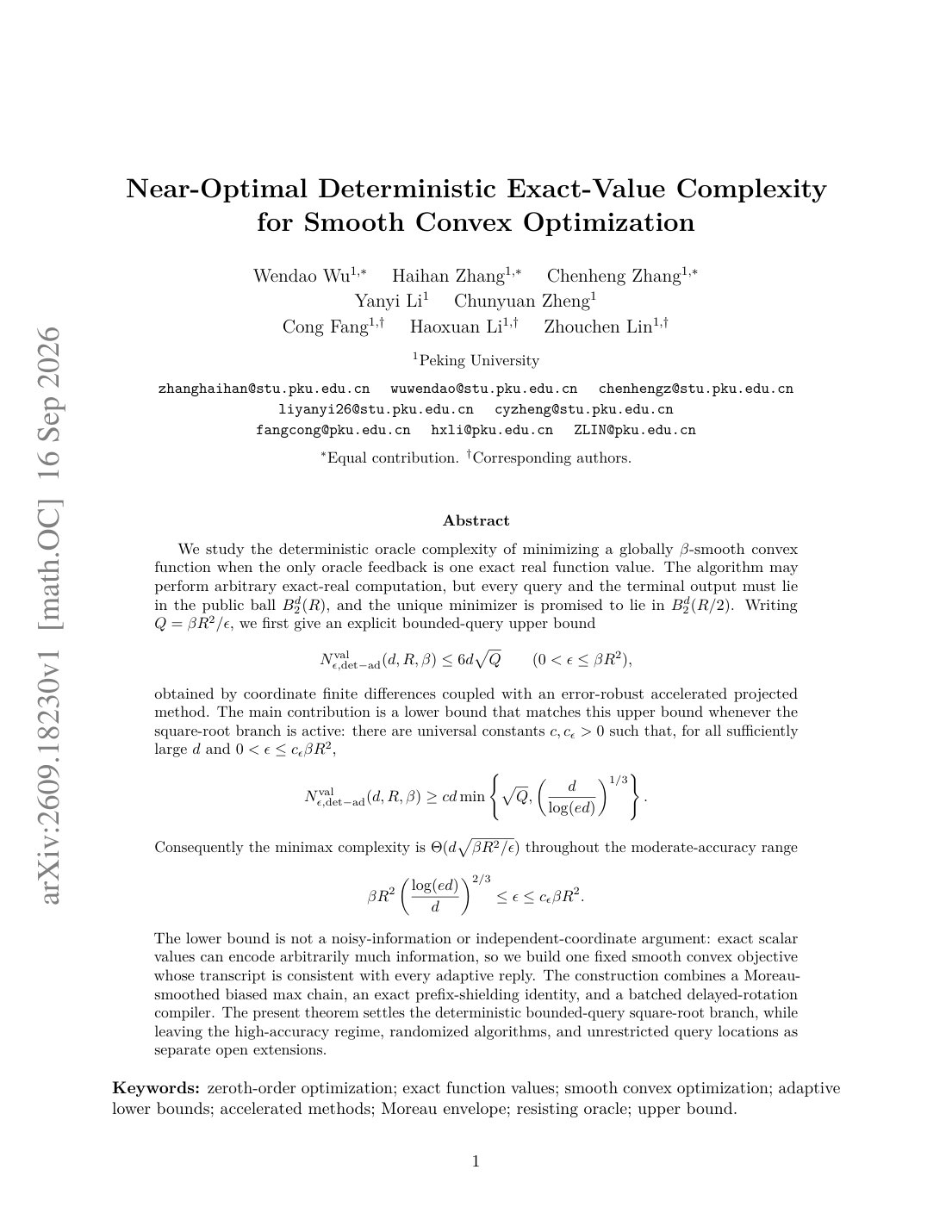
Tree-independence number of $P_5$-free graphs with no large bicliques
The tree-independence number of a graph is the minimum, over all tree-decompositions of the graph, of the maximum size of an independent set contained in a bag. Graph classes of bounded tree-independence number have strong structural and algorithmic properties; however, the parameter can be unbounded even in quite restricted classes. In particular, the presence of an induced biclique $K_{\ell,\ell}$ forces tree-independence number at least $\ell$. This leads to the question whether large induced bicliques are the only obstruction to bounded tree-independence number in natural hereditary classes. A conjecture of Dallard, Krnc, Kwon, Milani\v{c}, Munaro, \v{S}torgel, and Wiederrecht states that for all positive integers $t$ and $\ell$, ${\{P_t,K_{\ell,\ell}\}}$-free graphs have bounded tree-independence number. We prove this conjecture for ${t=5}$ by showing that every ${\{P_5,K_{\ell,\ell}\}}$-free graph has tree-independence number at most ${4\ell-4}$. We also obtain related bounds for the weaker parameter of $\alpha$-degeneracy and answer a question of Hilaire, Milani\v{c}, and Vasi\'c whether tree-independence number of ${\{P_5,K_{\ell,\ell}\}}$-free graphs exceeds $\ell$ by at most an additive constant.
Tree-independence number asks for a tree decomposition whose bags contain only small independent sets. It is weaker than controlling bag size, yet it still supports structural and algorithmic consequences. The immediate obstruction is induced bicliques: itself forces tree-independence number at least . The harder question is whether excluding large induced bicliques removes the remaining obstruction inside a natural hereditary graph class.
The authors resolve that question for induced five-vertex paths. They prove that every graph with neither an induced nor an induced has tree-independence number at most . This confirms the case of a conjecture asking for bounded tree-independence number in all -free graph classes.
Core Contribution
The contribution is a structural theorem rather than an experimental result. For every positive integer , the two forbidden-subgraph conditions imply a linear upper bound on the largest independent set occurring in a bag of a suitable tree decomposition. The bound is explicit, , rather than an unspecified function of .
The proof works by improving a carefully selected decomposition. The authors identify a local configuration that violates a desired normal form, then replace the decomposition with one that is better under a secondary criterion. The induced- restriction is essential: it excludes adjacency patterns that would otherwise make the repair fail. The argument therefore turns a global decomposition parameter into a local forbidden-pattern analysis.
Technical Approach
The construction partitions vertices around a chosen vertex and two vertices in its neighborhood. It defines a set and a boundary set consisting of vertices in that have neighbors outside . Figure 1 depicts this split. The proof then derives restrictions on how components outside can connect back through the boundary. When an assumed adjacency is missing, the authors exhibit five vertices that induce a ; these contradictions force the attachment structure needed for the decomposition surgery.
The repair separates a master copy of the tree for from copies associated with components outside , then reconnects them through controlled bags. Figure 3 illustrates this master-and-component construction. In the simpler case, the master bags retain their intersection with and add specified boundary vertices, while component bags combine local vertices with a constrained attachment set. A separate, more involved argument handles the case where the chosen pair is a bad pair.
The coefficient four comes from the independent-set accounting in a modified master bag. The proof splits an independent set according to its relationship with and neighborhoods of and , bounding the resulting pieces by , , and . Thus,
Component bags admit a direct bound under the same forbidden-biclique condition, while the bad-pair case requires additional structural claims to preserve the global threshold.
Results and Analysis
There are no datasets, runtime measurements, or empirical comparisons; the evidence is a mathematical proof. The central quantitative result is the universal upper bound, and the proof maintains it through both decomposition cases. That is enough to establish the conjectured boundedness statement for .
The theorem identifies induced bicliques as a controlled obstruction in the -free setting, but it should be read as a specific advance rather than a full resolution of the wider conjecture. It does not cover arbitrary forbidden path lengths , and the displayed upper bound does not by itself establish the best possible coefficient. Its value is primarily structural: researchers studying decomposition parameters and algorithms on hereditary graph classes can use the theorem as a boundedness guarantee in the -free case.
Evidence Box
theoreticalKey Claims
- •P5-free graphs without induced Kℓ,ℓ have bounded tree-independence number
- •The Dallard et al. conjecture holds for t=5
- •Local decomposition repairs control independent sets in modified bags
Key Results
- •Tree-independence number at most 4ℓ−4 for every {P5,Kℓ,ℓ}-free graph
- •Master-bag analysis sums 2ℓ−2, ℓ−1, and ℓ−1 to obtain 4ℓ−4
- •The proof treats 2 cases: a bad pair and a non-bad pair
Limitations & Caveats
- •Proof restricted to the t=5 case of the {Pt,Kℓ,ℓ}-free conjecture
- •No matching lower bound establishing whether the 4ℓ−4 coefficient is tight
- •No runtime or implementation analysis for constructing the decomposition