Silent War of Attrition Maximizes Targeted-Loss Exposure
A linear-program dual shows that assigning revenue-equivalent payments to losing states reaches the highest stress-test exposure for every bidder count $n \geq 2$.
Underlying Paper
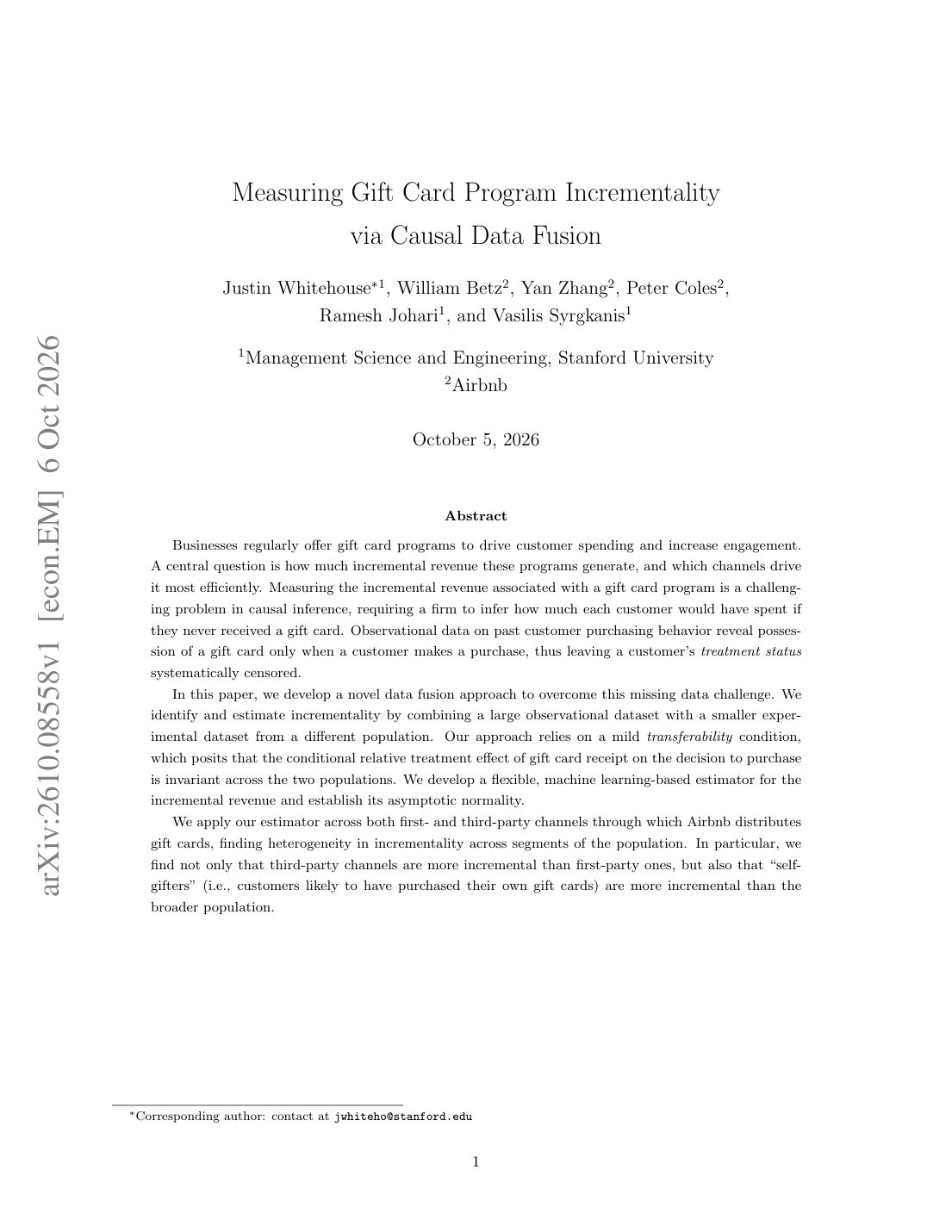
The Targeted-Loss Exposure Frontier in Auctions
Pay-to-bid auctions charge participants before allocation and therefore make losing-side payments vulnerable to seller intervention. This paper introduces targeted-loss exposure, a stress test that records a designated bidder's payment when one rival's equilibrium report is fixed at an arbitrarily high level while her type distribution is preserved. Under nonnegative payments and an ordering in which a winner pays at least as much as a loser, revenue equivalence yields a sharp two-bidder bound attained by the silent war of attrition. For any number of bidders, the same format attains the upper bound among payment-ordered rank-local rules. The proof formulates payment location as a linear program and constructs a dual probability measure. With more than two bidders, complementary slackness determines the optimal loser-payment schedule almost everywhere. Winner-pay auctions have zero exposure, standard all-pay auctions lie strictly below the frontier, and frontier exposure decreases as the number of bidders rises. A loser-only rule shows that removing payment ordering can make exposure unbounded. A common-shock extension also shows that anticipating intervention changes bids but preserves the ordering of standard formats. The results separate the total interim payment fixed by revenue equivalence from the winning or losing state to which that payment is attached.
Pay-to-bid auctions collect money before allocation, so a seller who can manipulate which reports prevail may expose participants to payments in states that ordinary equilibrium analysis treats as rare or off path. The paper studies that architectural risk rather than fraud, welfare, or the probability of an equilibrium loss. Its proposed diagnostic, targeted-loss exposure, fixes one rival’s equilibrium report at an arbitrarily high value while retaining the designated bidder’s type distribution, then records her expected payment when that intervention guarantees her loss.
Core Contribution
The central separation is between a bidder’s interim expected payment and the state in which the mechanism collects it. Revenue equivalence fixes the former under the paper’s assumptions, but it does not determine whether payment comes from winning or losing. The authors argue that this payment location is the relevant design variable when commitment to honest execution is weak.
For two risk-neutral bidders with independent private values, nonnegative transfers, efficient allocation, and payment ordering—winner payment at least as large as loser payment—the paper proves a pointwise upper bound. At each imposed rival report , targeted-loss payment cannot exceed the revenue-equivalent interim payment ; at the top type, exposure is at most . The silent war of attrition attains that bound, despite an equilibrium bid that diverges at the endpoint while its expected payment remains finite.
This is a narrower claim than “war of attrition is optimal” in a general auction-design sense. It is optimal for this intervention-based loss metric within the specified payment constraints.
Technical Approach
For , the paper restricts attention to payment-ordered rank-local rules: a loser’s payment depends only on her own type, while a winner’s payment depends on her type and the highest rival type. In this class, target-loss exposure reduces to the average loser-payment schedule, . Revenue equivalence imposes an integral constraint linking that schedule to .
The authors turn the resulting maximization into a linear-program relaxation over nonnegative measurable loser-payment schedules. The silent-war-of-attrition schedule satisfies the constraint at equality. A dual probability measure then upper-bounds every feasible schedule by the same value, establishing the frontier. Complementary slackness adds a sharper conclusion for more than two bidders: when , any optimal mechanism’s loser-payment schedule agrees with the silent-war-of-attrition schedule almost everywhere. For , the frontier is not unique; the appendix constructs a continuum of distinct implementing mechanisms.
The mechanism-level interpretation is concrete. A first-price or Vickrey rule attaches payments to winning and therefore has no targeted-loss exposure. Standard all-pay attaches the revenue-equivalent payment to every outcome, but remains below the frontier because its loser-payment kernel is smaller than the war-of-attrition kernel in the interior.
Results and Analysis
The paper’s comparison is analytic rather than empirical. Corollary 3.3 gives , with the last inequality binding only for two bidders. It also proves that both frontier exposure and the interior silent-war-of-attrition bid decrease strictly as bidder count rises. Thus the two-bidder contest is the most exposed configuration in this class, not merely a convenient special case.
The payment-ordering assumption does most of the substantive work. The appendix’s loser-only rule preserves truthful reporting, efficient allocation, zero utility for the lowest type, and the same interim payment , yet under uniform values its loser fee behaves as and produces infinite targeted-loss exposure. That counterexample shows why revenue equivalence alone cannot bound intervention risk.
A common-shock extension tests whether bidders anticipate a seller-controlled event that makes both genuine bidders lose with probability . Bids change, but the ordering remains: first-price and Vickrey exposure stay zero, all-pay remains below war of attrition, and both positive exposures decrease with . The formal evidence supports the paper’s conditional frontier claim. It does not establish how often real operators can intervene, whether bidders are risk neutral, or whether rank-local payment rules describe deployed pay-to-bid platforms.
Limits in Practice
There are no simulations, field data, or laboratory experiments; the paper is a formal characterization. Its conclusions rely on independent private values with continuous positive density, symmetric strictly increasing equilibrium reporting, nonnegative payments, and—beyond the two-bidder bound—rank locality. The diagnostic is useful for comparing payment architectures under an intervention scenario, but it is not a measured estimate of consumer harm or seller misconduct.
Evidence Box
theoreticalKey Claims
- •Targeted-loss exposure separates interim payment from payment location
- •Silent war of attrition reaches the payment-ordered exposure frontier
- •Winner-pay rules eliminate targeted-loss exposure
- •Payment ordering is necessary for a finite frontier
Key Results
- •For every n ≥ 2, first-price and Vickrey exposure equal 0
- •For every n ≥ 2, all-pay exposure is strictly below war-of-attrition exposure
- •For two bidders, frontier exposure reaches E[V] at the top type
- •Under uniform values, the loser-only fee scales as 1/[n(1−v)] and exposure is infinite
Limitations & Caveats
- •No empirical, simulation, or laboratory evaluation
- •Analysis assumes independent private values with continuous positive density
- •n-bidder frontier restricted to payment-ordered rank-local rules
- •Targeted-loss exposure is not a welfare or realized-harm measure