Fisher Information Propagation Gets a Sharp Local Proof
A BBGKY argument couples entropy and Fisher-information inequalities to extend Lacker’s chaos method to smooth mean-field diffusions.
Underlying Paper
Propagation of chaos in Fisher information
We present a new method for proving sharp local propagation of chaos in Fisher Information for particles with smooth interaction and drift. We rely on a new Lemma computing the Fisher Information of two diffusion processes with smooth drifts and fine estimates on the hessian of the law of the solution of the McKean-Vlasov equation. It allows us to obtain a new propagation of chaos in Fisher information, generalizing Lacker's seminal work by using the BBGKY hierarchy to obtain a system of differential inequalities satisfied by both the relative entropy and the Fisher Information of k particles. We also show with a simple Gaussian example that our decay rate is optimal.
Propagation of chaos asks whether a finite set of particles in an interacting -particle diffusion behaves, as grows, like independent copies of the McKean-Vlasov limit. Relative entropy has become a useful way to make that statement quantitative, but Fisher information is harder: it differentiates the density, so the BBGKY hierarchy produces terms involving gradients, Hessians, and cancellations that do not appear in entropy alone. This paper targets that gap for systems with smooth drift and interaction.
The authors’ claim is a local-in-particle result: for fixed or growing , the -particle marginal of the -particle system remains close to the -fold product law of the nonlinear limit in Fisher information, with the rate shown to be sharp by a Gaussian example. The contribution is not a new particle model. It is a proof mechanism for a stronger mode of chaos.
Core Contribution
The main step is to make Fisher information compatible with the BBGKY hierarchy. Lacker’s earlier entropy method controls the relative entropy of marginals by deriving a hierarchy of differential inequalities. Grass, Guillin, and Poquet extend that structure to Fisher information by tracking the time derivative of the Fisher information of a marginal density relative to the tensorized McKean-Vlasov law.
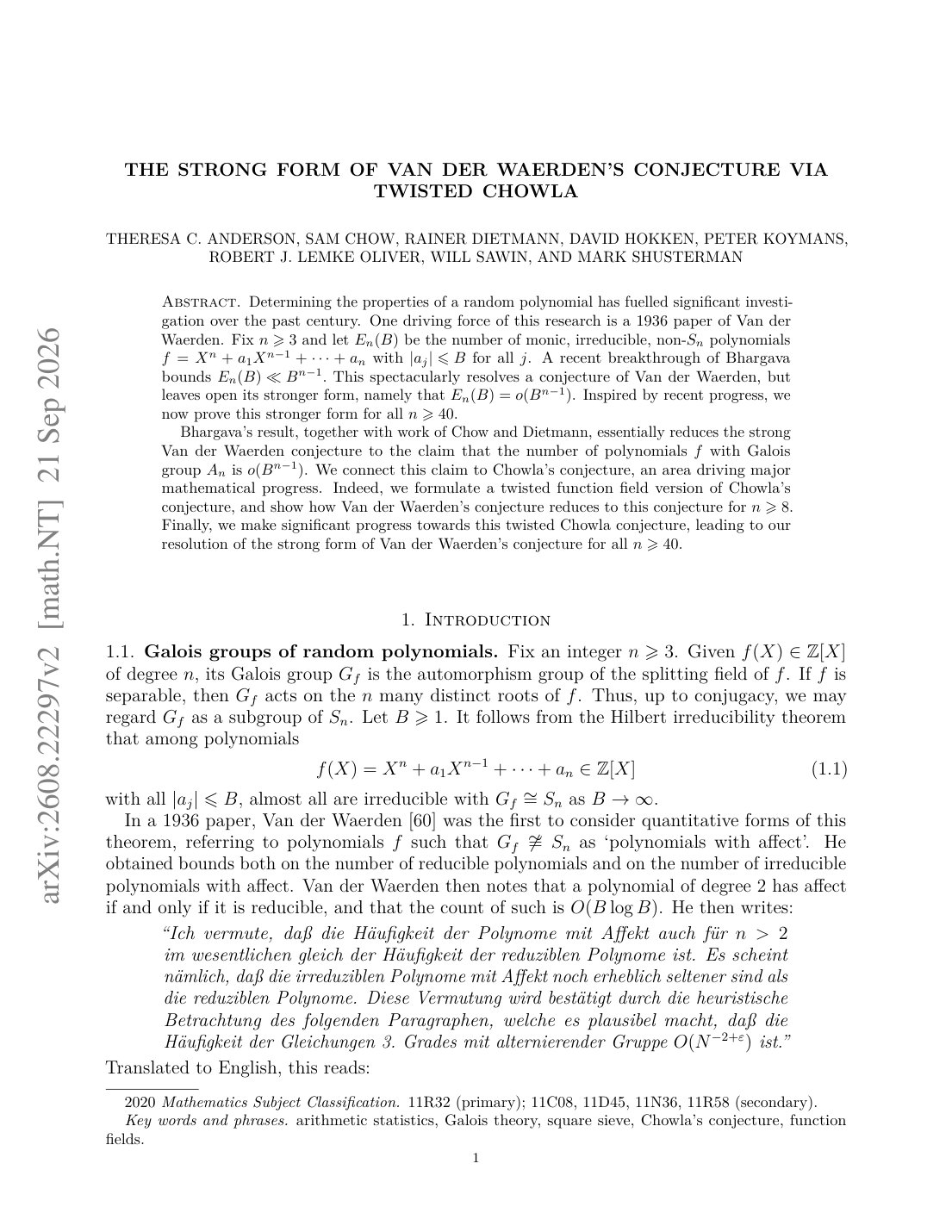
The paper’s new lemma computes how Fisher information evolves for two diffusion processes with smooth drifts. That calculation is the technical hinge: it exposes the exact interaction terms that must cancel and the higher-derivative terms that need separate bounds. The proof pages show the style of the argument: repeated integration by parts, decomposition into terms such as , , and , and cancellations including , , and .
Technical Approach
The system is a mean-field diffusion with smooth interaction and drift. The -particle law is compared with the McKean-Vlasov law, and the authors study the -particle marginals through the BBGKY hierarchy. In entropy-only arguments, the central object is the relative entropy of the marginal against the product limit law. Here the hierarchy must also control Fisher information, so the proof follows coupled quantities: an entropy term and a Fisher-information term, with error terms depending on the mismatch between the true finite-particle drift and its McKean-Vlasov counterpart.
A simplified version of the analytic burden is visible in the estimates around equations (14)–(16): after integration by parts, the Fisher derivative contains terms with , , drift differences, and Hessians of the reference law. The authors bound these terms using smoothness of the interaction and drift, then use cancellations to prevent the second-derivative terms from overwhelming the estimate.
Results and Analysis
For a theory paper, the evidence is the proof rather than a numerical experiment. The paper establishes a propagation-of-chaos result in Fisher information under smoothness and tail assumptions, and it does so locally at the level of -particle marginals rather than only globally for the full -particle law. The abstract states that the rate is sharp and that a simple Gaussian example proves optimality. That matters because Fisher information is a stronger topology than entropy: it controls score-level discrepancies, not just density-level divergence.
The result is best read as a sharpening of the entropy BBGKY program. The authors do not remove smoothness assumptions or treat singular kernels; the estimates explicitly rely on bounded derivatives of the drift, interaction, and McKean-Vlasov density. But within that regular regime, the paper gives a concrete route for controlling a quantity that usually breaks under hierarchy estimates. The Gaussian optimality example also limits how much improvement one should expect from a better proof alone.
Limitations
The assumptions are technical and meaningful. The interaction and drift are smooth, several derivative bounds are required, and the regularity proof uses Gaussian-tail-type control of the initial condition. The result is local in time and local in the number of observed particles, not a uniform treatment of arbitrary at fixed . There are no computational experiments, datasets, or released code; the paper’s value is the analytic method and the sharpness argument.
Evidence Box
theoreticalKey Claims
- •Sharp local propagation of chaos in Fisher information
- •BBGKY hierarchy extends from entropy to Fisher information
- •New two-diffusion Fisher-information lemma closes the hierarchy
- •Gaussian example shows the decay rate cannot generally improve
Key Results
- •36-page proof develops the Fisher-information hierarchy and regularity estimates
- •Lemma 2.4 computes Fisher-information evolution for 2 diffusion processes with smooth drifts
- •Equations (14)–(16) display cancellations among at least 10 decomposed Fisher derivative terms
- •Lemma 6.6 bounds derivative ratios through 3 density-derivative levels
Limitations & Caveats
- •Smooth drift and interaction assumptions exclude singular-kernel models
- •Regularity argument uses bounded derivatives and Gaussian-tail-type initial control
- •Result is local in time and for k-particle marginals rather than a fully uniform-in-k theorem
- •No empirical validation or computational artifact, since the contribution is analytic